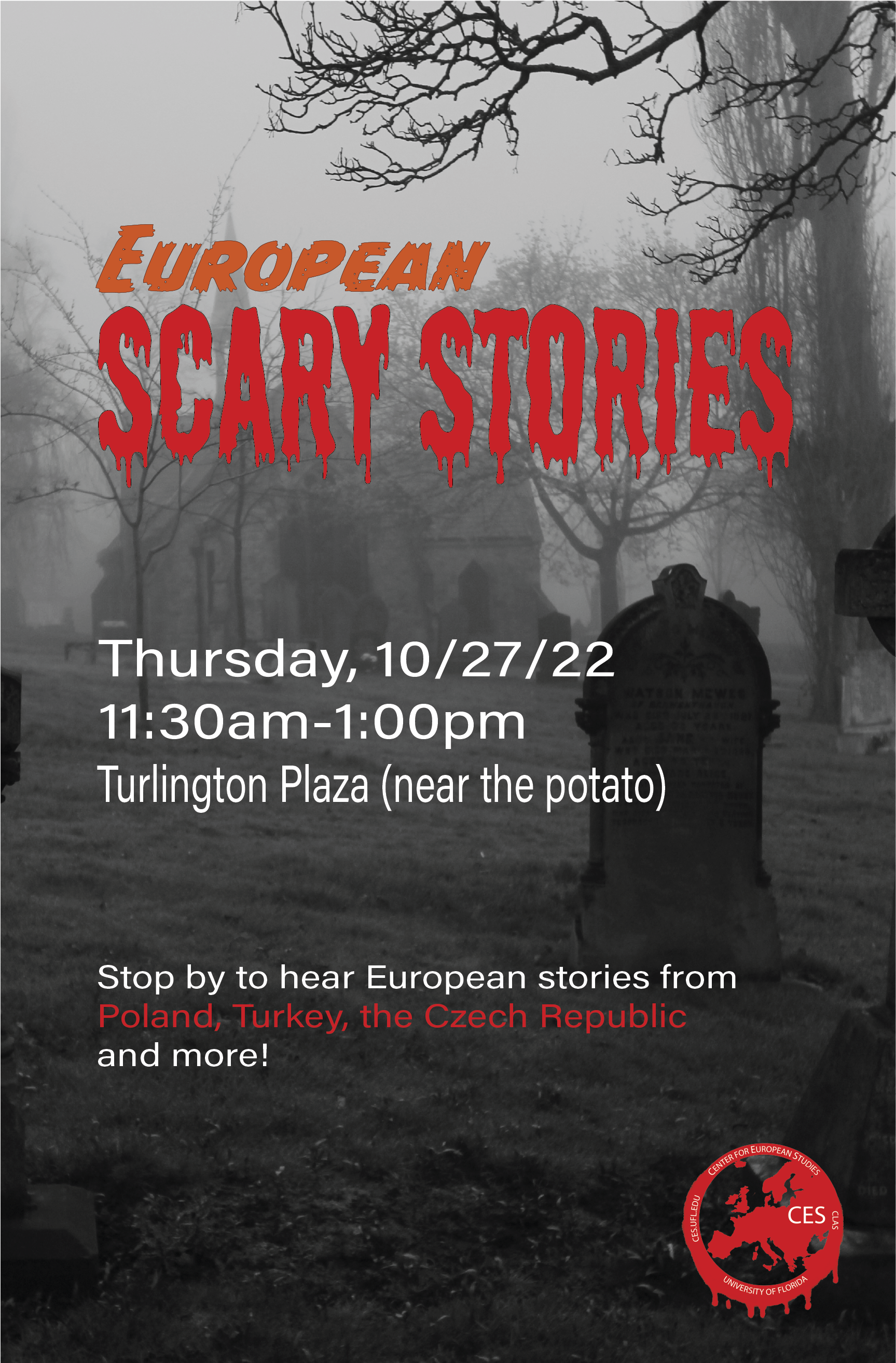
European Scary Stories
Thursday, 10/27, 11:30am-1:00pm
Turlington Plaza (near the potato)
Thanks for attending the Center for European Studies’ readings of European Scary Stories. Learn more about the stories and read some in their native languages here:
11:30 The Robber Bridegroom by the Brothers Grimm
Germany
The brothers Wilhelm and Jacob Grimm are credited with the birth of the modern study of folklore. Not only did they collect and record numerous folk tales, but they were also scholars who analyzed these stories and believed that they conveyed the rich beliefs of the people over centuries. Their collections and studies sparked widespread interest—enduring in stories like “Little Red Riding Hood” to this day—and similar studies across Europe.
This story is about a miller’s daughter who is set to marry an apparently rich and respectable suitor. The daughter, however, senses something off about her soon-to-be husband. When she embarks to visit him at his house in the dark woods, she discovers her bridegroom’s terrible secret . . .
11:45 The Legend of King Popiel
Poland
This the famous medieval story of King Popiel who ruled over Poland together with his German wife. They were selfish and cruel, however, and even disrespected religious customs, which eventually leads the people to rise up against them . . .
12:00 The Water Sprite (Vodník) & The Noon Witch (Polednice)
Czech Republic
These ballads by Karel Jaromír Erben incorporate old Czech folklore. “The Water Sprite” is the story of a young girl’s fateful encounter with the water sprite, and “The Noon Witch” recounts the tale of a “naughty” child that is taken away by the witch.
12:15 Jinns in Our House
Turkey
Jinns are well-known in Arabic mythology and are said to be invisible to the human eye and free from physical constraints. They can, however, take human or animal form or possess inanimate objects. Jinns, according to folklore, enjoy punishing humans and are therefore credited with causing accidents or diseases.
12:30 Witches’ Sun by Mehmet Berk Yaltirik
Turkey
This story, commissioned by the Turkey’s Fantasy and Science Fiction Arts Association (FABISAD), were part of the Pera Museum’s In Pursuit of an Artist: Istanbul-Paris-Istanbul exhibition. The stories are inspired by the artworks of Mario Prassinos, a major Surrealist painter of Turkish descent but who acquired French citizenship.
The story is set shortly after the end of the Balkan Wars, a dangerous territory of ambiguity. Our protagonist returns to his homeland under the pretense of being a French reporter. He is in the search of a friend, who disappeared on his search for “Witches’ Hill”; legend has it that whomever reaches the top of the hill becomes part of the “world beyond.”
12:45 Knowledge Obtained at the Crossroads
Hungary
Hungarian folklore has a long history in the country, serving as a form of entertainment and education. Toward the end of the eighteenth century, the stories also served the important function of asserting independence from the Hapsburger rulers.
This Hungarian folktale tells the story of János, who sees a carter perform some kind of healing magic with a rag on a horse. Eager to learn how it was done, he asks the carter where he obtained this knowledge. The carter tells him that Janos needs to go to the crossroads three nights in a row. He follows the advice, but the experience proves nightmarish and dangerous.